
Selective disclosure
eCrypt
Keep a document readable while protecting selected passages.
- For
- Writers and communities sharing partially private documents
- Access details
- Public editor; wallet-based access policies
- Purpose
- Infrastructure
On this page
Purpose
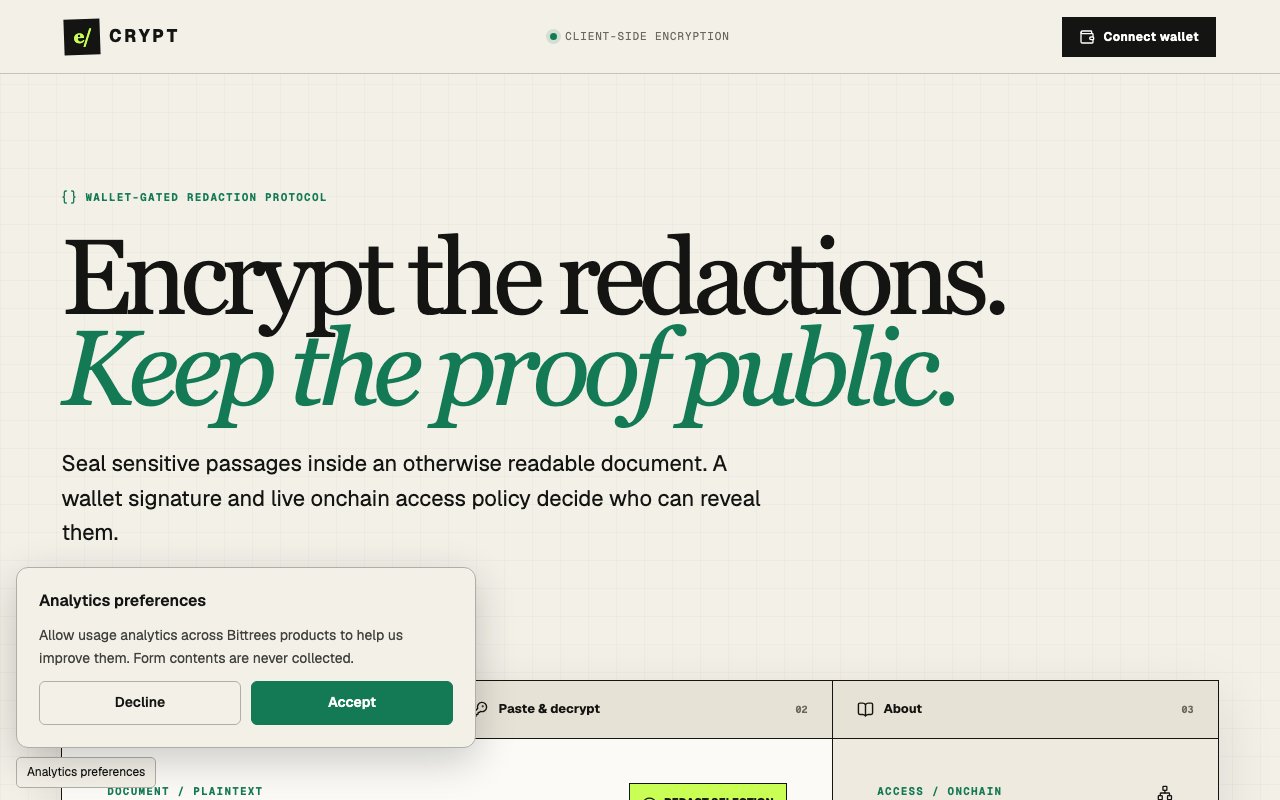
eCrypt publishes the parts of a document everyone can read while encrypting only the passages that need restricted access. It gives writers and communities a public record with a narrower audience for selected details. Its focus is selective disclosure rather than an entire private document workspace.
The product
The public editor lets a writer enter a document, select text for redaction and preview the result. Access conditions can refer to a specific wallet or token holdings, including ERC20, ERC721 and ERC1155 credentials. A separate paste-and-decrypt flow gives recipients a way to open shared material, with eligibility checked when they request access.
Community and sharing
The author defines who can reveal protected passages, making the sharing boundary part of the document workflow. A community can use wallet identity or membership credentials as that boundary instead of distributing the same private copy to everyone. Public text remains useful to a wider audience while qualifying recipients can request the additional context.
Integration
Encryption runs in the browser, while a key service and live onchain policies participate in access to protected content across Ethereum, Base and Robinhood. The service signs the complete package and uses commitments to detect altered public text or metadata. The project remains explicitly unaudited cryptographic software, and this review did not independently assess its cryptography or guarantee sensitive-data handling.
A good place to start
Explore the editor with non-sensitive sample text and inspect how a redaction policy changes the reader’s view before considering real use.